


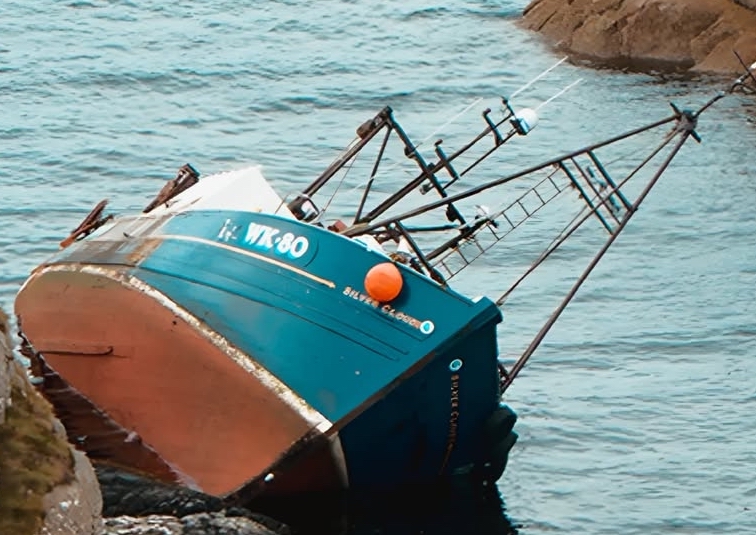
A fishing vessel that sailed from Stornoway on a night trawl ended up grounded on rocks near Lochinver after its skipper fell asleep at the wheel, a Marine Accident Investigation Branch report has found.
The Silver Cloud II, a 15.58-metre prawn trawler, left Stornoway at around 9.30pm on October 13, 2025, after landing its catch and carrying out repairs to a damaged net.
Just over three hours later, at around 2.38am, the vessel struck rocks at Rubha Rodha near Lochinver after travelling off course towards the Scottish mainland.
All three crew members escaped without injury and were subsequently rescued by the RNLI. The vessel, which was holed and partially flooded, later broke up and sank.
The newly published report by the Marine Accident Investigation Branch (MAIB) found that the skipper, who was alone in the wheelhouse, had fallen asleep sometime after taking over the watch at about 11.30pm.
The vessel was on autopilot and had been set towards a waypoint near the fishing grounds. When the skipper fell asleep, Silver Cloud II passed the waypoint and continued on a course of 092 degrees until it struck the shoreline.
The incident came after a particularly demanding period for the three-man crew. The Silver Cloud II had arrived in Stornoway at about 3pm on October 13 after a fishing net was found to be badly damaged.
While the skipper went to bed, the mate and deckhand repaired the net, landed the catch and had dinner. At about 9pm, the skipper got up and the crew decided to carry out a night trawl to make up for the fishing time lost earlier in the day.
The vessel departed Stornoway approximately half an hour later, with the mate keeping watch until the skipper took over at 11.30pm
The report found that the skipper had been suffering from flu-like symptoms during the trip, including a headache, sore throat, congestion and muscle aches, and had been taking paracetamol.
The investigation concluded that the skipper's rest had been "fragmented and limited" in the three days before the accident, with long working periods and multiple shorter periods of rest.
It found it was highly likely the skipper's rest had fallen below the statutory requirement of 77 hours over seven days.
The accident also occurred during what is known as the "window of circadian low" – normally between around 2am and 6am – when human alertness naturally falls and the likelihood of falling asleep increases.
The MAIB concluded that the skipper "very likely fell asleep" because of acute fatigue, made worse by illness and insufficient rest. The investigation also highlighted concerns about the vessel's watchkeeping arrangements.
Silver Cloud II routinely operated with just one person in the wheelhouse, with watches allocated informally according to the demands of fishing and travelling between ports and fishing grounds.
Although the vessel was fitted with a watch alarm, it required a button to be pressed every four minutes to prevent the alarm sounding. Crucially, there was no visual alarm or repeater in the crew accommodation.
The MAIB said it was highly likely that the alarm was masked by music playing in the wheelhouse on the night of the grounding.
The report noted that guidance on fishing vessel safety specifically identifies lone watchkeeping, distractions such as music and fatigue as contributory factors in collisions and groundings.
It also states that watch alarms should not be relied upon as the sole means of maintaining a safe navigational watch. Despite the failures that led to the grounding, the MAIB praised the crew's response once the vessel struck the rocks.
Around one metre of water was found rising in the fish hold and the skipper decided to abandon ship. All three crew members donned personal flotation devices and made their way ashore.
The skipper activated the vessel's emergency position indicating radio beacon and transmitted a distress alert before joining the other crew members on shore.
An RNLI lifeboat arrived at about 3am and recovered all three men.
The MAIB said it was "highly likely" that regular safety drills carried out on board had prepared the crew for the emergency, giving them the knowledge and experience needed to increase their chances of survival.
The Silver Cloud II was normally based at Ullapool and Gairloch, but its final voyage had a direct connection with Stornoway.
The port was the vessel's departure point for the ill-fated final passage, with the crew having called in to land their catch and repair the damaged net before deciding to undertake the additional night trawl.
The vessel was built in 1972 and had been purchased by Silver Cloud Shellfish Ltd in 2024. It was operated by a skipper, mate and deckhand.
The skipper and mate had each worked as fishermen for around 25 years, while the deckhand had approximately 12 months' experience. All three held the required Seafish certification.
The report classified the incident as a Very Serious Marine Casualty, although there were no injuries or fatalities. Perhaps most significantly for fishing communities in the Western Isles, the MAIB found that the circumstances were not an isolated case.
It highlighted similarities with previous investigations into fishing vessels where fatigued skippers had fallen asleep while keeping a lone watch.
A prawn trawler, Sustain, grounded at the entrance to Loch Broom in November 2023 after its skipper fell asleep.
More recently, in June 2025, the Crystal Stream grounded on Barmore Island after its skipper, also alone in the wheelhouse, fell asleep.
The MAIB said the recurrence of similar findings showed that the dangers associated with fatigue and lone watchkeeping were already well understood.
No new recommendations have therefore been issued following the Silver Cloud II investigation, with the branch stating that existing safety guidance remains directly applicable.
The report concluded that the combination of fatigue, illness, inadequate rest, lone watchkeeping and the limitations of the watch alarm system substantially increased the likelihood of the skipper falling asleep.
For the three crew aboard the vessel, however, regular safety drills and a rapid response to the grounding ensured that what could have been a tragedy ended without loss of life.
