


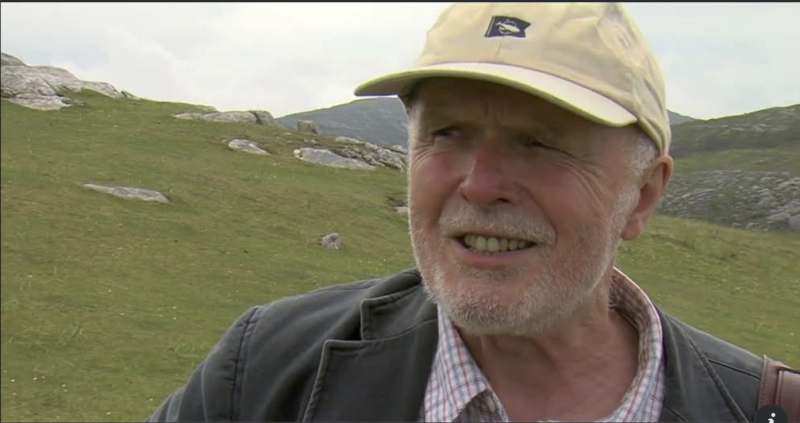
Photographer Gus Wylie – who became renowned for his photographic work across the Hebrides from the mid-1970s onwards – has died at the age of 90. Wylie’s death actually took place in January, but the news was not widely known until recently.
Wylie is described as a long-term chronicler of Scottish island life, and his home county of Norfolk, and much more besides. He was perhaps best known for his book, published in 2005 by Birlinn, The Hebrideans – The Photographs 1974-2004.
Originally a painter, Wylie taught at The Royal College of Art, London, the Rochester Institute of Technology, New York, and directed the MA in Fashion Photography at the University of the Arts, London.
He published five books, four of which are on the Western Isles and was awarded an Honorary Fellowship of the Royal Photographic Society in 2005.
He graduated three times at postgraduate level in, respectively, Fine Art, Photography and Cultural History, all of which were gained at the Royal College of Art, London, and the last of which was a PhD.
An exhibition of his work was held at An Lanntair arts centre in 2006. The photographs were described thus: “Although taken over a 30-year period, many of the iconic images date from the 70’s and 80’s and will bring back memories of recent history and show just how quickly life in the islands has changed. While not sentimental, the photos evoke nostalgia among those who remember the Rayburn stoves, the cows being pulled along the road, the wrecks on the moorland, the un-modernised interiors.”
Gus Wylie is remembered on-line by Adventure Show Productions as “indefatigable photographer of the Hebrides; inspirational teacher and a lovely person. Adventure Show Productions is sharing this film - with the family’s permission - that they made in 2010 for BBC Scotland as part of a major project on the Western Isles
https://www.youtube.com/watch?v=RjIkqdQWp28
Journalist and politician Torcuil Crichton said this week: “I’m sad to hear of the death of Gus Wylie, the photographer who defined a whole era of the Hebrides.
“In conversation with photographer John MacKinnon the other week Wylie’s name came up, as it often does when discussing images of the islands, but a check online showed he died in January, at the age of 90 years.
“Wylie’s body of work in the Hebrides in the 1970s and 80s caught a time of tremendous change, as the old world slipped away and modernity entered the frame.
“Cur is Dlùth, the first book, the Gaelic version, had a huge impact on me as a kid as a mirror to my own world.
Murdo MacLeod, from Shawbost, the Guardian photographer, recalled the connections with the late Dr Finlay MacLeod, of Adabrock and Shawbost, who was the photographer’s passport to island life.
“Finlay described Wylie’s pictures as more than the sum of their parts, which is true. “Yes, they’re just pictures, but somehow, they became a big part of where I came from.
Former film director and politician Michael Russell said: “I didn’t know he had died and am sorry to hear it. I remember him well and the link with Dr Finlay. He generously let me use one of his images as the cover for a book I wrote that followed Edwin Muir’s Scottish Journey. He and Oscar Mazzaroli were the great recorders and visual interpreters of the Western Isles in the last quarter or so of the 20th century.”
In an interview which Torcuil Crichton did with Gus Wyle around 20 years ago in the Herald, Torcuil wrote: “Gus Wylie's photographs - a body of work dating mainly from the 1970s and 1980s - defines our idea of what the Hebrides are like; or, now that life is lived at broadband speed, what the islands were like.
“The woollen jumpers tucked in by a leather belts have been replaced by the thermal fleece; the Rayburn stove has gone, and the underfloor heating is in; the Sheffield steel shears have rusted.
“And who, after all, would want time to stop for any longer than it takes a camera shutter to close? It is in these thin slices of seconds that Gus Wylie captured an era. When Wylie went to the "still sleeping Hebrides", as he'd heard them described, in the early 1970s, he found them rapidly shaking off their past.
“His pictures, particularly his intimate interior shots, are of a very specific time in the islands - the dawn of the Formica age when the huge Welsh dressers and the tongue-and-groove wall panelling were being thrown out to make way for the essentials of modernity: chipboard, plasterboard, televisions.
The tableaux are iconic of a time, yet the people are not stereotypes and the pictures lack sentimentality. In the detail they have an immediacy that brings them to life. The messages from the grocery van - the Saxa salt, the sliced bread, the orange juice - have just been plonked on the sofa. The spoon is still in the cup, stirring the tea.
“Some images have an intense symbolism. The hatpin as a signifier of the Sabbath; the shears at the fank illustrate ancient husbandry; the washing on the line and the wrecked car against the beautiful landscape stand as emblems of care and neglect. They are all as familiar as folds in a favourite item of clothing, defining the everyday and creating an intimacy with people we don't know but who surely can't be strangers.”
